Posts

Showing posts with the label Math Lecture Series

Table of Common Words Representing Math Operations

When interpreting word problems as math equations, it is a good idea to keep in mind that certain phrases will always represent a certain mathematical operation.  Here is a list of some of these words for the basic operations. Addition Subtraction Multiplication Division Equals Exponent Parenthases Add Subtract Multiply Divide Is To the power of Quantity Sum Difference Product Quotient Yields Raised to the Increased by Decreased by Times As much Set as Plus Minus Double ($\times 2$) Halve ($\frac{x}{2}$) Equal to More Less Triple ($\times 3$) A third ($\frac{x}{3}$) Determined to be Combined Change Twice...
Other Equations of Lines: Algebra Chapter 2 Section 5

Image
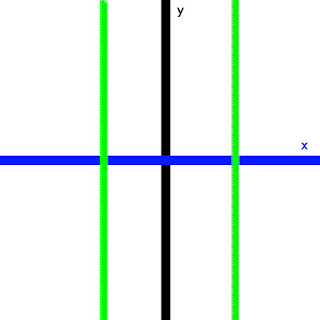
Hello internet, and welcome to the Algebra Lecture Series from The Science of Life.  This entry is focusing a little deeper into the concept of lines, especially the other equations of the line. Suppose that we have a line with slope $m$ and it passes through a specific point $(x_{1}, y_{1})$.  For any other general point (x, y) on the line (where $x_{1} \neq x$ and $y_{1} \neq y$) on the line, the slope of the line would be $m=\frac{y-y_{1}}{x-x_{1}}$.  Multiplying both sides of the equation by the denominator of the right hand side gives us $m \times (x-x_{1})=(y-y_1)$.  This final form is called the point-slope form of the linear equation, since we use a point and the slope. The two green lines are parallel. If we look at two parallel lines, they do not cross (they have no solution) by the definition of parallel lines.  This can only be done if the change in the y variable (the rise) for every unit change in the x variable are exactly the same ...

Another Look at Linear Equations: Algebra Chapter 2 Section 4

Hello internet, and welcome to the Algebra Lecture Series from The Science of Life.  This entry is an introduction to Linear Functions in both graphs and models. There are two situations where the slope would not be stated in the slope-intercept form.  These are cases where the line crosses only one of the 2 (or more) axes. First, let's consider the horizontal line.  If we have a line which has a y-intercept but does not have an x-intercept (does not cross the x-axis), it is called a horizontal line.  Let's look at it from the point of view of the slope-intercept form we developed last time, $y=mx+b$.  We know that the slope is the change in the y-value per change in the x-value.  If we have two points $(x_{1}, y_{1})$ and $(x_{2}, y_{2})$, the slope is mathematically defined as $m=\frac{y2-y1}{x2-x1}$.  The denominator, the $ dx=x2-x1$, is never going to be zero when there's a y-intercept, since we can go from the left of the y-intercept to th...