Posts

Showing posts with the label linear equations

Systems of Equations in Two Variables - Chapter 3 Section 1

Typically, problems involving at least two unknowns are solved by translating the problem to two or more equations, such as the slope-intercept form and/or the standard form of the line. Developing Equations from Sentence Form When deciphering word problems, we typically try to take a word or phrase which explains what a variable is and represent that word or phrase as a single letter instead. For instance, the energy consumed by your household so far this billing cycle can be represented by the letter E, and the total cost so far in that pay cycle can be represented by the letter C. It is also useful to translate commonly used words into mathematical operations. For example, the product of two things m and c represents multiplication, while the square of c represents squaring the letter c. So the product of the two values of m and the square of c would be $m \times c^2$. I will leave a table of some common and uncommon phrases and their mathematical translations here . Outs...
Other Equations of Lines: Algebra Chapter 2 Section 5

Image
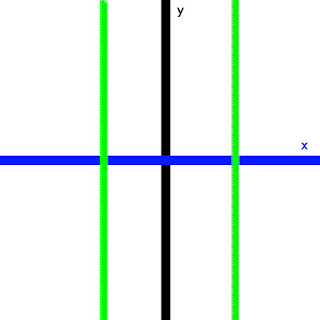
Hello internet, and welcome to the Algebra Lecture Series from The Science of Life.  This entry is focusing a little deeper into the concept of lines, especially the other equations of the line. Suppose that we have a line with slope $m$ and it passes through a specific point $(x_{1}, y_{1})$.  For any other general point (x, y) on the line (where $x_{1} \neq x$ and $y_{1} \neq y$) on the line, the slope of the line would be $m=\frac{y-y_{1}}{x-x_{1}}$.  Multiplying both sides of the equation by the denominator of the right hand side gives us $m \times (x-x_{1})=(y-y_1)$.  This final form is called the point-slope form of the linear equation, since we use a point and the slope. The two green lines are parallel. If we look at two parallel lines, they do not cross (they have no solution) by the definition of parallel lines.  This can only be done if the change in the y variable (the rise) for every unit change in the x variable are exactly the same ...

Another Look at Linear Equations: Algebra Chapter 2 Section 4

Hello internet, and welcome to the Algebra Lecture Series from The Science of Life.  This entry is an introduction to Linear Functions in both graphs and models. There are two situations where the slope would not be stated in the slope-intercept form.  These are cases where the line crosses only one of the 2 (or more) axes. First, let's consider the horizontal line.  If we have a line which has a y-intercept but does not have an x-intercept (does not cross the x-axis), it is called a horizontal line.  Let's look at it from the point of view of the slope-intercept form we developed last time, $y=mx+b$.  We know that the slope is the change in the y-value per change in the x-value.  If we have two points $(x_{1}, y_{1})$ and $(x_{2}, y_{2})$, the slope is mathematically defined as $m=\frac{y2-y1}{x2-x1}$.  The denominator, the $ dx=x2-x1$, is never going to be zero when there's a y-intercept, since we can go from the left of the y-intercept to th...

Linear Functions: Graphs and Models: The Algebra Lecture Series Chapter 2 Section 3

Image
Hello internet, and welcome to the Algebra Lecture Series from The Science of Life.  This entry is an introduction to Linear Functions in both graphs and models. Linear Equations are the easiest functions to conceptualize. They are lines which stretch out to infinity in both directions. On an x-y plane, the equation of a line can follow many forms, the first one usually introduced being the slope-intercept form y=mx+b, where m is the slope (change in the y-coordinate per 1 unit change in the x-coordinate) and b is the y-intercept (point where it crosses the y-axis). There are other forms of the equation of the line, but I'll get to those in future entries. If we have multiple points which form an obvious line, we can use two of those points to find the slope of the line. As mentioned earlier, the slope is the motion along the y-axis as the x-coordinate changes. With that in mind, we can use two points (x1, y1) and (x2, y2) to determine the slope. The slope is given by...

Conversions of Units, Estimates, and Order of Magnitude Calculations: The Physics Lecture Series Chapter 1 Sections 4 and 5.

Hello internet, and welcome to the Algebra Lecture Series from The Science of Life.  This entry is focusing on conversion of units that you'll see in Physics, Chemistry, Biology, and all of science. Unit Conversion The previous Physics section allows us a mechanism to convert from one unit to another unit of the same type.  To do this, we take advantage of the equivalence between two values, and multiply with what is effectively equivalent to one.  For example, notice that 1hr=60min.  If we divide both sides by 1hr, we get $\frac{1hr}{1hr}=\frac{60min}{1hr}$.  In all of science, units such as seconds, meters, and kilograms can be canceled if in a quotient or squared if multiplied together, much like variables.  With that in mind, notice that on the left hand side, the hours cancel and the ones cancel, so that we have $1=\frac{60min}{hr.}, which makes sense since there are 60 minutes per hour.  This general concept applies to all conversion facto...

Algebra Chapter 1 Section 3: Solving Equations

Image
In this third section of Chapter 1 , I will cover the basics of equation solving.  I've already touched on this in Physics , and will get to in in Chemistry; this is vital for all of math and science, including Economics. Equivalent Forms One of the most vital statements in Algebra is that two equations which have the same solutions are equations.  In all future endeavors, both science and in math, we look to solve for the variable that is unknown, and the final form of that equation doesn't look anything like the initial equation, but is in an equivalent form, so has all of the same solutions as the initial equations.  For any real numbers a, b, c, and d, $a+c=b+c$ is equivalent to $a=b$ and $a=b$ is equivalent to $a \times d=b \times d$.  What we can do from here is say that $a+c=b+c$ is equivalent to $a \times d=b \times d$. Like Terms In any equation, a "term" is any constant, variable, product of any number of constants and/or variables, or the qu...