Posts

Showing posts with the label Real Numbers

Algebra Chapter 1 Section 3: Solving Equations
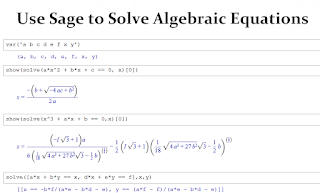
Image
In this third section of Chapter 1 , I will cover the basics of equation solving.  I've already touched on this in Physics , and will get to in in Chemistry; this is vital for all of math and science, including Economics. Equivalent Forms One of the most vital statements in Algebra is that two equations which have the same solutions are equations.  In all future endeavors, both science and in math, we look to solve for the variable that is unknown, and the final form of that equation doesn't look anything like the initial equation, but is in an equivalent form, so has all of the same solutions as the initial equations.  For any real numbers a, b, c, and d, $a+c=b+c$ is equivalent to $a=b$ and $a=b$ is equivalent to $a \times d=b \times d$.  What we can do from here is say that $a+c=b+c$ is equivalent to $a \times d=b \times d$. Like Terms In any equation, a "term" is any constant, variable, product of any number of constants and/or variables, or the qu...


Algebra Chapter 1 Section 2: Operations and Properties of Real Numbers

Image
Here, I will cover some of the basic operations and properties of real numbers. I say real numbers to differentiate from imaginary and complex numbers, both of which deal with the square root of -1, $\sqrt{-1}=i$. This course will not deal with the square root of -1, so all numbers will be real in this course. There are courses which deal with i, which typically have the word "Complex" in their name. The Absolute Value The absolute value (given by $\left | a \right |$) is the distance from the zero on the number line, regardless of the sign. This is to say $\left | -a |=\left | a |$.  The absolute value of -2 is 2, the absolute value of 2 is 2.  It does not matter what the initial value is, the sign after running it through the absolute value function will always, under every circumstance ever, be positive. Inequalities There are two types of inequality, less than and "greater than".  There are also two flavors of inequality, with and without the equal s...

Algebra Chater 1 Section 1: Some Basics of Algebra

Image
In this first section from Chapter 1 , I'll cover some basics of Algebra, including basic terminology. Basic Terms: When a letter is used for a stand-in for a value which can take up any range of numbers, we call it a variable.  When a letter is used to represent a specific number (typically when we don't know what it is, but there can only be one), it is said to be a constant. Our Constants An example of this is the gross pay; the pay on your pay check before taxes is given by P G =H×W, where H is the hours worked and the W is your hourly wage.  Since hourly wage doesn't change from week to week, it is considered to be constant.  If you work part time, than your hours in any given week is considered a variable, because they do tend to change. An algebraic expression consists of a combination of constants, variables, and operation signs.  For example, H×W from the pay equation above is considered an expression.  When an equals sign is placed ...

Chapter 1: Algebra and Problem Solving

Image
Algebra is the mathematics of equalities and inequalities.  How much you'll spend at the grocery store, what you'll get on a paycheck after taxes, how much you'll owe or get back in taxes at the end of the year, how much money you'll have left at the end of the month after paying your bills; all of these problems and so many more are, by their very nature, algebraic problems. In this chapter, I'll cover some basics of Algebra and how to problem-solve with Algebra.  Problem solving can be applied to science, economics, and life.  After learning the algebraic problem solving techniques, you should try applying them to the specifics of your life. For those of you keeping track, here's the section breakdown: Section 1: Some Basics of Algebra Section 2: Operations and Properties of Real Numbers Section 3: Solving Equations Section 4: Introduction to Problem Solving Section 5: Formulas, Models, and Geometry Section 6: Properties of Exponents Sectio...