Posts

Showing posts with the label charge

Other Equations of Lines: Algebra Chapter 2 Section 5
Image
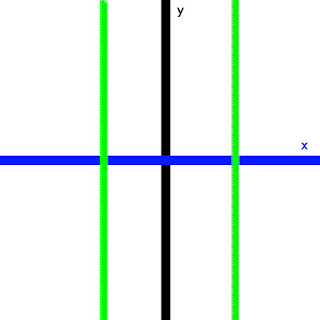
Hello internet, and welcome to the Algebra Lecture Series from The Science of Life.  This entry is focusing a little deeper into the concept of lines, especially the other equations of the line. Suppose that we have a line with slope $m$ and it passes through a specific point $(x_{1}, y_{1})$.  For any other general point (x, y) on the line (where $x_{1} \neq x$ and $y_{1} \neq y$) on the line, the slope of the line would be $m=\frac{y-y_{1}}{x-x_{1}}$.  Multiplying both sides of the equation by the denominator of the right hand side gives us $m \times (x-x_{1})=(y-y_1)$.  This final form is called the point-slope form of the linear equation, since we use a point and the slope. The two green lines are parallel. If we look at two parallel lines, they do not cross (they have no solution) by the definition of parallel lines.  This can only be done if the change in the y variable (the rise) for every unit change in the x variable are exactly the same ...

Algebra Chapter 1 Section 7: Scientific Notation

In science, there are many numbers which are either exceedingly large (for example, the number of water molecules in a liter of water) or exceedingly small (for example, the charge, in Coulombs, of a single electron).  This is the nature of the reality we live in.  This is why, in some cases, it is easier to read and right these extremely small and large values in a more compact notation.  Yes, this does somewhat reduce accuracy, but the loss of accuracy has very little baring on the accuracy of the final answer.  The most common compact notation in Social Sciences, Life Sciences, and Physical Sciences is called Scientific Notation . The notation for Scientific Notation is $N \times 10^{n}$, where N is a number which is at least 1 but less than 10 $[1 \le N < 10]$ and n is the magnitude of the number.  There are a couple steps to convert to scientific notation: Place a decimal point in between the first two significant digits of the number. Find the m...