Posts

Showing posts with the label solving equations

Chapter 2: Graphs, Functions, and Linear Equations
Image
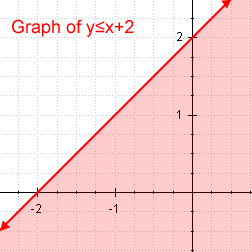
Graphs are an important part of Algebra since they allow us to visualize information from the equations of Algebra.  After all, we deal better with the visual than the equation.  When we have an equation of two variables, we can see how they relate to one another more readily in a graph than in an equation. The course of Algebra focuses on the concept of functions (which will be defined in Section 2; because yes, functions are different than equations).  Most of the graphs considered here are what is called linear equations, equations which produce lines.  This chapter has the purpose of not only teaching the basics of graphing functions, but also using them for problem solving. Section 1: Graphs Section 2: Functions Section 3: Linear Functions: Graphs and Models Section 4: Other Equations of Line Section 5: Other Equations of Lines Section 6: The Algebra of Functions That's the end of this section.  If you have any questions, please leave ...
Algebra Chapter 1 Section 6: Properties of Exponents

In the first section of this lecture series, I touched on positive integers as exponents.  Now I will delve further into the rules of exponents. Let's say that we're multiplying two exponents, $x^{5}$ and $x^{2}$, together.  Notice that $x^{2}=x \times x$ and $x^{5}=x \times x \times x \times x \times x$.  This means that if we multiply those two values together, we have $x^{2} \times x^{5}=(x \times x) \times (x \times x \times x \times x \times x)=x \times x \times x \times x \times x \times x \times x$.  This means that $x^{2} \times x^{5}=x^{7}$.  This means that when you're multiplying two exponents together, so long as the two bases are the same, all that needs to be done is adding the two exponents together, $x^{2} \times x^{5}=x^{5+2}=x^{7}$. We can use the same concept for division (quotients), $\frac{x^{5}}{x^{2}}$.  Notice that this yields $\frac{x^{5}}{x^{2}}=\frac{x \times x \times x...

Algebra Chapter 1 Section 5: Formulas, Models, and Geometry

Here, I will describe some of the basics of algebraic manipulation.  First, we need to define a formula, which is any equation which uses letters to represent relationships between quantities.  An example of this is the area of a circle, $A=\pi r^{2}$.  You'll remember from Section 3 that we can solve for a variable.  The formula I used was the one relating masses of two object, their distance, a constant, and the Gravitational force. To solve a formula for a particular variable or constant, perform the following steps: Multiply both sides by any denominator there happens to be in order to cancel out any denominator and clear any fractions.  Combine like terms. Using the addition principle, get every term with the variable to be solved for on one side of the equals sign and every other term on the other side of the equals sign.  Combine like terms again if necessary, which may include factoring. Solve for the variable by using the multiplicatio...

Algebra Chapter 1 Section 4: Introduction to Problem Solving

Hello internet, and welcome to the Algebra Lecture Series from the Science of Life.  This entry is an introduction to algebraic problem solving.  In Algebra, there are five steps for problem solving, which I'll cover here. Familiarize yourself with the problem situation.  This is basically a situation of knowing what the context of the problem is.  Is the context taxes?  Grocery shopping?  Tipping?  Scaling up or down the ingredients of a cake to get a different size cake than what the recipe says the size will be?  Here are the sub-steps for this contexts step: Read the problem carefully.  Read it aloud if need be to understand the problem. List the information and state the question being asked.  Select variables to represent anything which is unknown and clearly state what the variables represent, and be descriptive about the statement. Obtain any relevant information and equations.  If you're painting a room, find the ...

Algebra Chapter 1 Section 3: Solving Equations

Image
In this third section of Chapter 1 , I will cover the basics of equation solving.  I've already touched on this in Physics , and will get to in in Chemistry; this is vital for all of math and science, including Economics. Equivalent Forms One of the most vital statements in Algebra is that two equations which have the same solutions are equations.  In all future endeavors, both science and in math, we look to solve for the variable that is unknown, and the final form of that equation doesn't look anything like the initial equation, but is in an equivalent form, so has all of the same solutions as the initial equations.  For any real numbers a, b, c, and d, $a+c=b+c$ is equivalent to $a=b$ and $a=b$ is equivalent to $a \times d=b \times d$.  What we can do from here is say that $a+c=b+c$ is equivalent to $a \times d=b \times d$. Like Terms In any equation, a "term" is any constant, variable, product of any number of constants and/or variables, or the qu...